
Older New England homes
Knob & Tube Replacement in Westford, Newton & Greater Boston
- Licensed & insured
- Free estimates
- Warranty-backed work
Knob & Tube Replacement
Good work for its time. Not for this one.
Knob and tube was the standard way to wire a house from the late 1800s into the 1930s: individual conductors run on porcelain knobs, passing through framing in porcelain tubes, with connections soldered and taped. Installed well, it could last a long time. The problems come from what it wasn’t designed for, and from what’s been done to it since.
It has no ground. The insulation, often rubber and cloth, gets brittle after nearly a century. It was designed to shed heat into open air, so when a later owner blew insulation into the walls or attic, those conductors started running hotter than intended. And after decades of add-ons, many systems have newer cable spliced into old runs in ways nobody would sign off on today.
Towns like Lowell, Cambridge, Somerville, Newton, Belmont and Arlington have a lot of housing from that era. We often find a house that’s been ‘mostly rewired’ with one or two old knob and tube circuits still feeding a bedroom or the attic lights. Finding those last runs is where experience matters.
“He was on time. He was knowledgable and explained everything very well. He was friendly, helpful and efficient. He finished everything in one day even though he had to go and get a part, which he did very quickly. I was very pleased.”
Signs to watch for
How to tell if you still have knob and tube.
You don’t have to find it yourself, but these are the usual giveaways.
- 01
Porcelain knobs in the basement or attic
White ceramic spools nailed to joists with single wires running between them are the classic sign.
- 02
Two-prong outlets on older plaster walls
Not proof on their own, but in a pre-1940 house they’re a strong hint about what’s behind them.
- 03
Fuses or a very old panel
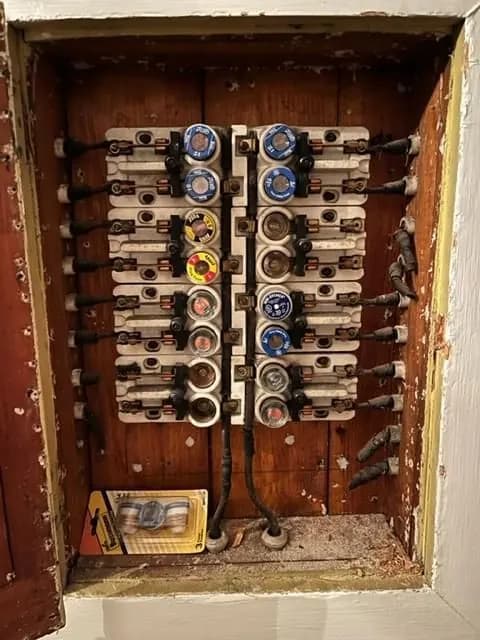
Knob and tube often survives in houses that also kept an old fuse panel or early breaker panel.
- 04
Insurance or lender questions
Many insurers ask about knob and tube directly. Some won’t write or renew a policy until it’s gone.
- 05
Insulation on top of old wiring
Blown-in insulation covering knob and tube is a specific hazard, since the wire can’t shed heat the way it was designed to.
- 06
A home inspection flagged it
If you’re buying or selling, a report that mentions knob and tube needs a real evaluation of how much is live.
What the job involves
What replacement looks like.
Old houses reward patience. Here’s how we keep the job clean and predictable.
- 1
Find every live run
We trace circuits from the panel and test at devices, attics and basements to map which knob and tube is still energized and what it feeds.
- 2
Honest scope
You get a written estimate that separates what must go now from what’s already dead and can simply be disconnected and left.
- 3
Plan routes around the plaster
We use basements, attics, closets and baseboards to run new cable, and keep openings small and easy to patch.
- 4
Replace and disconnect
New grounded circuits go in with proper boxes and modern protection. Old runs are disconnected at the source so they can’t be re-energized.
- 5
Inspection and paperwork
The work is permitted and inspected. You get documentation you can give your insurer or a buyer.
Why it matters
Safety, insurance and peace of mind.
The biggest reason to replace knob and tube is fire risk that increases with age and with changes to the house around it. Modern cable gives you a ground path, insulation rated for being enclosed in walls, and circuits that work with the AFCI and GFCI protection current code expects.
The practical reasons are almost as strong. Insurance companies and lenders ask about it. Buyers’ inspectors write it up. And you get outlets that take three-prong plugs without adapters. For a lot of our customers, replacing the last of the knob and tube is what finally lets them stop worrying about the wiring.
- Every live run located
- Plaster-friendly routing
- Grounded new circuits
- Documentation for insurers
Knob & Tube Replacement FAQ
Questions we get about this work
Is knob and tube illegal?
Existing knob and tube isn’t automatically illegal, but it can’t be extended, and insulation over it is a problem. Insurers and lenders often require replacement regardless of what code allows to remain.
Can you just replace the circuits that are still live?
Yes. Dead runs can be disconnected and left in place. We focus the budget on circuits that are actually energized.
How long does it take?
It depends on how much is left and how accessible the house is. A few circuits might take a couple of days; a full house takes longer. We give you a schedule with the estimate.
Will you have to open my plaster walls?
Some openings are usually needed, but we keep them small and put them where they’re easy to repair. Attics, basements and closets do a lot of the work.
Can I finance knob and tube replacement?
Yes. Financing is available on larger projects like this one.
Related services
Often done together.
Free estimates · Financing · Warranty
Ready to talk knob & tube replacement?
Call Monday to Friday, 8:00 to 4:30, or send a note and we’ll get back to you with a time for your free estimate.